Letter from the Editor
We’ve seen it. We’ve seen societies free themselves from the seemingly ironclad hold of insane ideas. Once upon a time, for example, it was the common understanding around the world that human slavery was part of the natural order of things. Historian Adam Hochschild drew that horrifying picture precisely for us in a great book 20 years ago:
[T]he vast majority of people are prisoners. Most of them have known no other way of life. They are not free to live or go where they want. They plant, cultivate, and harvest most of the earth’s major crops. They earn no money from their labor. Their work often lasts twelve or fourteen hours a day. Many are subject to cruel whippings or other punishments if they do not work hard enough. They die young. They are not chained or bound most of the time, but they are in bondage, part of a global economy based on forced labor. Such a world would, of course, be unthinkable today.
But this was the world – our world – just two centuries ago, and to most people then, it was unthinkable that it could ever be otherwise. At the end of the eighteenth century, well over three-quarters of all people alive were in bondage of one kind or another, not the captivity of striped prison uniforms, but of various systems of slavery or serfdom.
And then — boom! Boom, in a cosmic sense. Three-quarters of all people alive. In a flash, about a generation or two, people around the world realized that such a system was aberrant, contrary to the rights of man — and they abolished it. Hochschild writes:
Looking back […], what is even more astonishing than the pervasiveness of slavery in the late 1700s is how swiftly it died. By the end of the following century, slavery was, at least on paper, outlawed almost everywhere. The antislavery movement had achieved its goal in little more than one lifetime.
Likewise colonialism, with its comprehensive systems of oppression (Hochschild writes about those, too) across Africa and Asia. Boom! In the 1950s, 1960s, 1970s — and then, poof! Communist/Leninist/Stalinist totalitarianism — in the 1990s — pow! Paradigms changed. I remember how, in February 1990, as the Berlin Wall was coming down, former political prisoner Václav Havel came to address a joint session of the U.S. Congress, gathered to celebrate his victory. In June, South Africa’s Nelson Mandela, after 27 years in prison himself, came to do the same.
Again, paradigms had changed.
Today, we have a world of stink again, burbling full of dreck. Monstrous personalities, entertainers, and ideologues alike have inherited or seized the most powerful states. Businesses of a size we have never seen tighten their grip upon the world. Inequalities in wealth and access to knowledge overwhelm any calculation or benefit in data collection. Our most important media networks, once the most trusted in the world, circulate information that’s barren of truth. The guilty escape justice, and the innocent are imprisoned by ignorance and debt.
But — cling to history. Those who despair today can never give up hope — they have to draw inspiration from the past. Not only the inspiration to survive in times of darkness, but to prepare for the moment when they reach up and flip the switch.
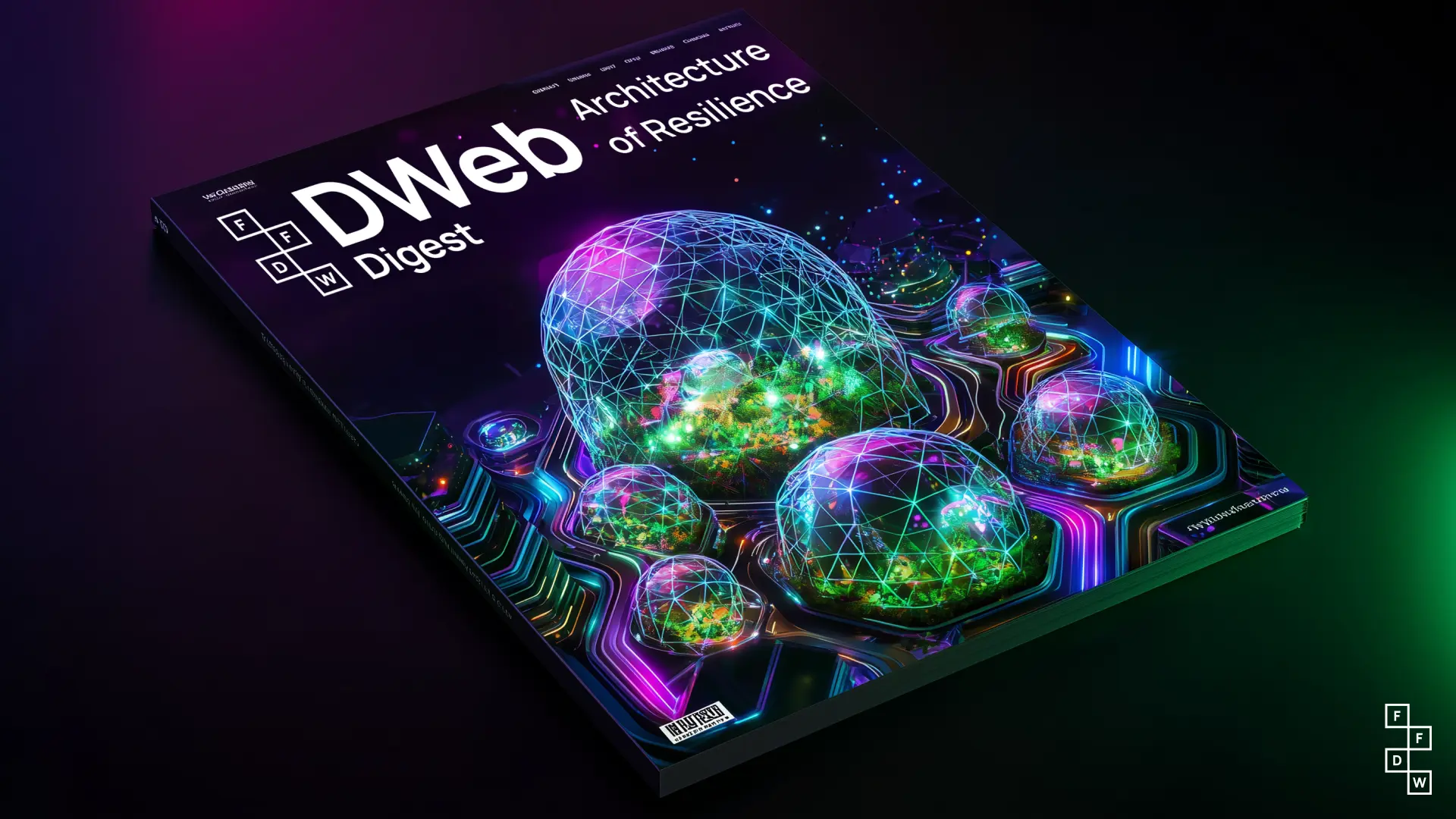
Inspiration is what this issue of the Digest is about. Inspiration is also what Filecoin Foundation for the Decentralized Web (FFDW) has been providing by supporting, for the past several years, what it calls its social impact community. That community is one that my institution, MIT, is proud to be a member of.
The seven essays that follow describe the path-breaking, breathtaking work of Starling Lab, the Internet Archive, the Prelinger Archives, Gray Area, the Flickr Foundation, TRANSFER, Lighthouse, and WITNESS, among others. The forms of writing vary — a decentralized design manifesto (Starling), a profile of a changemaker (Prelinger), a Q&A (with Gray Area instructors), reports on using decentralizing storage technology (Flickr and TRANSFER), on building those same technologies (Lighthouse), a field report on the present challenges of their use in the wild (WITNESS). But taken together, they illustrate bravery in action and invite a paradigm change in the present rather than a century later.
This collection is about technology and media: the instruments that get new and true ideas into our heads, and from there, outward into reality. Those who control the spread of ideas control how we understand and shape the world. The contribution about Prelinger Archives and the Internet Archive details the almost unbelievable scope of what these organizations do (the IA is about to celebrate preserving its trillionth link of the web). The contribution from Gray Area reminds us that we have to work toward “democratic, solidarity-based systems of governance over the design and stewardship of network infrastructure,” and that building decentralized technologies is part of (to remember Hochschild) “a practice of liberation.” And all of these contributors are building what we’ve decided to call, for this issue of the Digest, the architecture of resilience.
Author Bio
Peter B. Kaufman is Associate Director for Development at MIT Open Learning and a writer and producer.